Scoped to your move
No one-size price list. Your rate reflects your inventory, your stairs, your parking, and your kilometres.
West End movers who know the 1960s walk-ups with no elevator, the one-way streets, and the diverters. One flat rate scoped to your actual stairs and parking.
Every West End quote is a flat rate scoped to your move: what you own, the access at both ends, and the distance between them. No hourly meter ticking while you wait on a loading zone.
No one-size price list. Your rate reflects your inventory, your stairs, your parking, and your kilometres.
Someone who has carried a couch up a Vancouver walk-up reviews every quote before it goes out. The price we confirm is the price you pay.
New couch? Extra stop? We review the price with you before move day. Nothing changes without a conversation.
Every West End move packs the same way: our uniform tubs fill the truck floor to ceiling, wall to wall, then the furniture goes in. No loose boxes stacked on your couch.
The West End is the densest neighbourhood in Canada, and it moves like it. Thousands of apartments packed into a few dozen blocks, most of them in buildings put up before elevators were standard, on streets that were deliberately made hard to drive through. Nothing about a West End move is difficult once it is planned. All of it is difficult when it is not.
The West End's housing stock is dominated by three to six storey buildings from the 1950s and 1960s. Some have small elevators. Many have none at all, and those that do often have cabs too small for a mattress to lie flat.
The questions that decide the job are always the same:
None of this shows up on a floor plan, which is why we ask directly rather than pricing on bedroom count. It is also why a flat rate works well here: these constraints are all knowable before move day, and once known there is no honest reason for the price to change.
Very few West End buildings have off-street loading. The practical answer for almost every address is a temporary no-parking permit from the City of Vancouver, which reserves a stretch of curb outside the building for the day. It requires several business days of notice.
This is not optional in the way people sometimes hope. West End curb space is contested at every hour, and a truck without a reserved spot will end up parked far enough away that the carry becomes the dominant cost of the move. We arrange the permit conversation when the date is booked.
The West End was deliberately engineered to discourage through traffic. Concrete diverters, forced turns and one-way sections mean that the shortest route on a map is frequently not a route at all for a five-tonne truck.
This is entirely manageable and completely invisible if you plan for it. We work out the approach before move day, including which direction the truck needs to arrive from to end up on the correct side of the street for the permitted curb space. Getting that wrong means reversing a large vehicle on a narrow residential block, which is slow and best avoided.
Denman, Davie and Robson add their own constraint: heavy pedestrian traffic all day, restricted curb hours, and delivery vehicles competing for the same few metres. Buildings on those three streets need earlier starts than the quieter blocks around Nelson Park and Barclay.
Around Barclay Heritage Square and scattered through the side streets, the West End still has genuine heritage houses and converted early-century buildings. These bring narrow front doors, original staircases, and sometimes protected features that a crew needs to be careful around.
They are good buildings to move in and out of as long as the inventory is scoped honestly. The recurring problem is modern furniture in pre-war doorways: sectionals, king mattresses and large wardrobes. We would rather identify those at quote time and plan a route, a disassembly or a window lift than improvise on the day.
The West End's own traffic is manageable; the problem is everything around it. The Burrard and Granville bridges queue outbound from mid-afternoon and the Lions Gate approach through Stanley Park is unpredictable at almost any hour.
Where the schedule allows we load in the morning, which also lines up with the quieter part of the day on Denman and Davie. Moves that stay inside the neighbourhood are short, straightforward, and mostly a question of stairs.
Most of what we do here is people moving within the West End, often into a slightly better building on a slightly quieter street. There is a steady flow in from students and new arrivals who want to be able to walk everywhere, a steady flow out to Kitsilano and the North Shore when people want space, and a great deal of downsizing from houses elsewhere in the city into apartments near English Bay.
The price we confirm is the price you pay. Whether it is a fourth-floor walk-up off Nelson or a one-bedroom on Beach Avenue, the quote is built from your actual stairs, your actual parking, and your actual inventory.
Ready for a number? Get your flat-rate quote and tell us the floor, whether there is an elevator, and what the street looks like; those are the three things that decide most of the price.
Real photos from real Nash moves. Whatever's odd-shaped in your West End place, it goes in the plan the same as the couch.
 A Dalí dancer, crated by hand
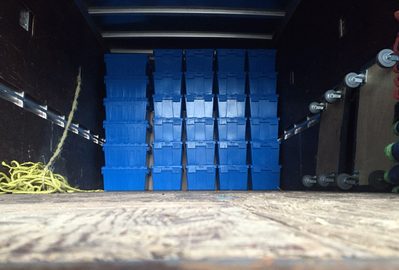 Tubs stacked wall to wall
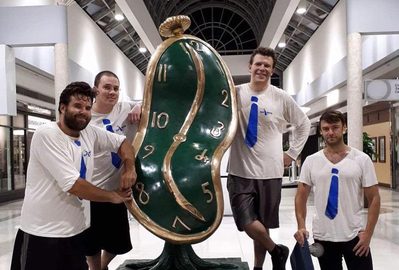 A Dalí clock, right on time
Nash Moving helped my parents move recently and were fantastic. My parents loved how friendly, fast and efficient they were. The guys were always happy and really seemed to enjoy what they were doing. Highly recommend.
Nash Moving is the way to go! Nate, Aaron and their team are master packers and movers. Fast, efficient and very professional. Their years of experience really showed throughout the process.
Thank you Nash Moving for helping myself and my many clients move!
It changes the time the move takes, and time is what the flat rate is scoped from, so it is priced in up front rather than added later. What we need to know is the floor and whether the stairs turn at each landing. A third-floor walk-up with tight landings is a genuinely different job from a third floor with an elevator.
Almost always with a temporary no-parking permit from the City of Vancouver, requested a few business days ahead, which reserves a stretch of curb outside your building. Very few West End buildings have usable off-street loading. Tell us the address when you book and we will tell you what your block needs.
Not for us, but it is a real routing constraint and it is why we plan the approach in advance. The West End's diverters and one-way sections mean a truck often cannot take the direct route, and the difference between the right approach and the wrong one can be ten minutes of reversing. We work it out before move day.
Usually, and occasionally only in pieces. Many West End buildings from the 1950s and 1960s have narrow entry doors, tight corridor turns and small elevators where they exist at all. We ask about the big items at quote time so we arrive with the right tools and, if something genuinely will not fit, you hear it from us before move day rather than during it.
Usually yes, because distance is one of the inputs to your flat rate and the West End is compact. The stairs and the parking matter more here than the kilometres do, which is why we scope those carefully and the drive barely at all.
Plenty of our West End moves start or end a few blocks over.
Buildings we've written up in West End
We move every address in West End, tower or walk up. These are the ones with a page of their own, down to the loading dock and the elevator rules.
Pick a date and we'll carry it straight into your quote. Not sure yet? You can skip it.
Get your West End quote →Five minutes to a real price, and a real person to stand behind it.
Prefer to talk it through? Call (778) 322-2462